|
|
 |
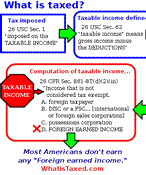
(Or "Except as otherwise provided"
- 26 USC 61)
| The formula for Income tax, which is written in Title 26 USC Sec. 63(a), is actually very simple ...
Taxable income=(gross income-deductions)
 So, is section 861 really frivolous? Are tax-cheat criminals getting what they deserve, or are tax court judges and the IRS the real criminals? So, is section 861 really frivolous? Are tax-cheat criminals getting what they deserve, or are tax court judges and the IRS the real criminals?
To find the facts, just ask the Government's own computer, because U.S. laws are written in code.
Search engine: http://www.gpoaccess.gov/uscode/search.html
Search for (copy/paste line into search box): 26usc* AND "gross income" AND "citizen"
Notice, how many results are foreign related.
Also, notice section 861.
Now, add one more keyword, to see if we can narrow the search results.
26usc* AND "gross income" AND "citizen" AND "united states"
Apparently, even when including the "united states", a quarter of the results are foreign related, and still produces the same sections.
Again, notice section 861.
Now try other key codewords in the Income tax formula.
26usc* AND "deductions" AND "citizen" AND "united states"
26usc* AND "taxable income" AND "citizen" AND "united states"
As you can see, according to the "code", section 861 is not frivolous at all.
Section 861 is the law.
How to Search U.S. Tax Code
 Step 1. Pick a search engine
Start with the Government Printing Office search engine.
Hint: Right-click link, then Open in New Window
- Government Printing Office (GPO):
www.gpoaccess.gov/uscode/search.html
- Cornell Law School:
www4.law.cornell.edu/uscode/search/uscode26.html
- US House of Representatives:
http://uscode.house.gov/search/criteria.shtml
Not user-friendly. Use single quotes here.
- Fourmilab:
www.fourmilab.ch/ustax/TaxSearch.html
* Use single quotes here
- Find Law:
Use Search by Keyword
www.findlaw.com/casecode/uscodes/
Not user-friendly.
Step 2. Perform a Search
A) Simple Search
A simple search can include any "code" between two quotes.
Copy and paste the following lines into a search
engine. You may see some search engines work better with single
quotes.
- "income from sources within the United States"
- "taxable income from sources within the United States"
- "gross income from sources within United States"
- "expenses, losses, and other deductions"
- "class of gross income"
- "gains, profits, and income"
- "gross income specified"
|
The Code does not lie.
Section 861 is the law.
Short on time?

Search for:
- 26USC* AND "taxable income" AND "citizen"
AND "united states"
- 26USC* AND "deductions" AND "citizen"
AND "united states"
 |
Did you notice Sec. 861 through 865? These are the sections which lower
courts & IRS say are frivolous.
But, you'll find there are many more simple search results
like these in tax regulations, that's because...
"Treasury Regulations (26 C.F.R.)--commonly referred to as Federal
tax regulations-- pick up where the Internal Revenue Code
(IRC) leaves off"
- IRS www.irs.gov/taxpros/article/0,,id=98137,00.html#26cfr
Due
to it's lack of specifics, it is more effective to use a boolean
search to find codified instructions in the USC.
B) Boolean Search
 What
is boolean? What
is boolean?
A boolean
search is useful for finding multiple "code-words" within
the same section, e.g. "code-term-1" AND "code-term-2"
AND "code-term-3". By using one or more ANDs it is possible
to find the exact section of law written for any topic.
For example...
 Which sections provide the code for "taxable income"
of a "citizen" of the "United States"?
Which sections provide the code for "taxable income"
of a "citizen" of the "United States"?
Enter the following into search box
- "taxable income" AND "citizen" AND "united
states"
Fact: Among thousands of sections in tax code only
20 have the "code-words." Notice, Sec. 861, 863, 864, and
865 are all included in search results.
Frivolous? Judge? ... Senator? ... Congressman?
Being more specific, Which sections provide the code for "deductions"
and "expenses"?
- "taxable income" AND "gross income" AND "deductions"
AND "expenses" AND "united states"
Sec. 861. Again? Coincidence?
Which sections have the code for taxable sources of income?
- "taxable income" AND "sources" AND "united
states"
Notice, Sec. 861 is not so frivolous.
(Adding 26USC* to your boolean search string will confine
your search within Title 26 [Internal Revenue Code].... But,
try searching with and without 26USC*, just so you know that you've
searched through every statute that's been written.)
- 26USC* AND "deductions" AND "citizen" AND "united
states"
- 26USC* AND "gross income" AND "citizen" AND
"united states"
- 26USC* AND "gross income" AND "included" AND
"united states"
- 26USC* AND "gross income" AND "deducted" AND
"united states"
- "gross income" AND "deductions" AND "united
states"
- "taxable income" AND "deductions" AND "united
states"
- "items" AND "taxable income" AND/OR "gross
income "
- "items" AND "deducted" AND "gross income"
OR "taxable income"
- "taxable income" AND "included" AND "united
states"
- "deductions" AND "allocated" AND "gross income"
- "sources" AND "gross income" AND "taxable
income"
- "individual" AND "citizen" AND "taxable
income" AND "included" AND "united states"
- "individual" AND "citizen" AND "resident"
AND "taxable income" AND "included" AND "united
states"
- "individual" AND "citizen" AND "taxable
income" AND "gross income" AND "included"
AND "united states"
- "items" AND "sources" AND "included"
AND "deducted" AND "taxable income" AND "united
states"
- "income" AND "deducted" AND "within united
states"
- "sources" AND "gross income" AND "taxable
income" AND "individual"
- "taxable income" AND "items" AND "united
states"
- 26USC* AND "sources" AND "gross income" AND
"united states"
- "sources" AND "gross income" AND "united
states citizen"
- "allocation" AND "gross income" AND "citizen"
- "allocation" AND "gross income" AND "within
the united states"
- "taxable income" AND "within united states"
- "gross income" AND "within united states"
- "deductions" AND "within united states"
- "the following items" AND "shall be treated as income"
- "gains" AND "profits" AND "gross income"
AND "taxable income"
- "gains" AND "profits" AND "gross income"
AND "deductions"
- "gains" AND "profits" AND "gross income"
AND "deducted"
- "gains" AND "profits" AND "shall be deducted"
- "gains" AND "profits" AND "shall be included"
- 26USC* AND "gains" AND "profits" AND "united
states"
- "gains, profits"
- "items of gross income" AND "united states"
- "items of gross income" AND "taxable income"
- "items of gross income" AND "deductions"
- "items of gross income" AND "allocated"
- "items of gross income" AND "allocation"
- "items of gross income" AND "apportion"
- "items of gross income" AND "apportioned"
- "items" AND "allocated" AND "gross income"
- 26USC* AND "items" AND "income" AND "shall
be deducted"
- 26USC* AND "expenses" AND "income" AND "shall
be deducted"
- "items" AND "gross income" AND "citizen"
- "gross income" AND "taxable income" AND "citizen"
- "sources" AND "taxable income" AND "citizen"
- etc, etc...
 Did
you see enough of Sec. 861 through 865? Did
you see enough of Sec. 861 through 865?
Frivolous or obvious? 
Sec. 861 could not be the result if it was not precise.
In codification, something is true or false. There is no in-between
... only fact, true or false.
Judges, Where is your 'honor'? Why don't you allow the law in your
courtroom? ("Everyone who does evil hates the light."
- John 3:20) More importantly,
why don't you obey the truth? Justice requires it. If there really is
a law, why don't you simply provide the section number to those who
ask? What exactly did they teach you in tax school? Did they even mention...
"Exempt income" is legally
defined?
The law defers, and refers users to the US tax regulations ("under
regulations prescribed by the Secretary" - 26
USC 863). Statutes and regulations do not command, or demand from
citizens any tax on domestic income. Only a government policy,
fabricated by politicians and enforced by police demands
our money, time, and life... it is not law.
The Income Tax is a modern-day slave system composed of illegal policies,
corrupt politicians, and ignorant police ... the same
system used in all organized crime; mafia.
There is only one list of taxable items, as it should be.
The list is located in 26 CFR 861-8T. It says... only a foreigner's
income, and foreign earned incomes are taxable incomes*. Sec.
861 may be the only law written which the Government does not want you
to follow.
* This assumes proper authority, jurisdiction, citizenship, being an
employee, earning wages, etc, are valid and have previously existed.
But, all of these are questionable at best, and all of these could be
the topics of their own websites.
Data mining can be performed in every title of law or regulations.
For example: Homeland Security, Federal Elections, Banking, Food and
Drugs, Alcohol, Tobacco and Firearms, Judicial Administration, Money
and Finace: Treasury, Pensions, Public Health, etc, etc. All of the
policies made under color of law can easily be found.
Ignorance of the law is no excuse ... for fraud or treason.
Download a copy of the tax code.
With the following websites you can get your own copy
of the tax code to compare results from sources above. Note, these downloads
cannot be boolean searched.
|
|
|
|
Attention Researchers
If any link has disappeared, try to copy and
paste the link address at http://www.archive.org
-- DISCLAIMER --
The intended purpose of this website, WhatisTaxed.com,
is to data mine with a computer the Internal Revenue Code, and
the Code of Federal Regulations, Title 26, for the "codes" (e.g.
taxable income, gross income, excluded income, eliminated income,
exempt income, deductions, allocation, apportionment, etc),
for rules, and instructions, for determining income tax. The
results have been published throughout this website. It should
be evident these search methods may be applied to any Title
of Law, or large volume of text, and in any country that
has codified laws and rules. See How to Search.
Nothing is for sale at WhatisTaxed.com.
Information posted at WhatisTaxed.com should not be
considered legal advice and is solely for educational purposes.
The reader should not rely on information provided herein to
determine tax.
Do not accept this
website as tax advice.
WhatisTaxed.com is only tax research from data mining tax
law.
To contribute - See How to Search, and Contact
Us.
We do not sell, promote, or advise anything,
but data-mining, searching, and reading tax code with the only
appropriate code tool ... your computer.
We do find every occurrence of a particular
code-term to establish precisely what is written, and what is
not written in tax law. When we say, no other rule
or statute exists - for example, regarding excluded
income, we show you how many files contain this important
code term, and how we searched for it with a computer. You can
easily verify any of the laws, rules, or code-terms in question,
and you should verify every result because it is your duty
to know and follow the law. Ignorance is no excuse.
You are
responsible for doing your taxes.
Questions: If you have questions, try asking
your Congressperson or Senator.
Ask your lawmaker to explain these Sec. 861 search
results ...
- "eliminated income" - Sec. 1.861-8(d), 1.861-8(d)(2),
1.861-8T(d)(2)
- "excluded and eliminated items of income" - Sec.
1.861-8T(d)
- "eliminated items" - Sec. 1.861-8T(d)
- "excluded income" - Sec. 1.861-8 and 1.861-8T
- "income that is exempt or excluded" - Sec. 1.861-8T(d)(2)
- "specific sources" - Sec. 1.861-8(a)(1)
- "specific guidance" - Sec. 1.861-8(a)(1)
- "how to determine taxable income" - Sec. 1.861-8(a)(1)
- "the rules [of Sec. 1.861-8 ...] for determining
taxable income" - Sec. 1.863-1(c)
- "Exempt income ... defined" - Sec. 1.861-8T(d)(2)(ii)
- "income that is not considered tax exempt" [i.e.
taxable income] - Sec. 1.861-8T(d)(2)(iii)
Source: http://ecfr.gov
Ask your Congressman and Senator ...
If "Exempt income" is "defined"
in Sec. 861, why is Sec. 861 frivolous?
Find your Congressperson: http://www.house.gov
Find your Senator: http://www.senate.gov
Answers: If you want answers, you can try
asking the press - the American
media and foreign
media.
The Code of Federal Regulations
When searching tax law, we pay close attention
to 26 CFR...
"the Official Interpretation"
"Federal Income Tax Regulations
(Regs) are the official Treasury Department interpretation of
the Internal Revenue Code"
- Internal
Revenue Manual, 4.10.7.2.3.1
"Federal Tax Regulations pick
up where the Internal Revunue Code (IRC) leaves off by providing
the official interpretation of the IRC"
- http://www.irs.gov/taxpros/article/0,,id=98137,00.html
The Code of Federal Regulations are the rules, written
in plain English, which both the public and the IRS must follow:
"The Service is bound by the
regulations."
- Internal
Revenue Manual, 4.10.7.2.3.4
Since "the Service is bound," we can be sure that
we are playing by the same rules. It does not require a law
degree to understand them. See How to Search and Search Examples.
|
|