http://WhatisTaxed.com: Data-mining the Tax Code
A Simple Diagram
In a Nutshell.
Who is taxed.
According to Law
Videos
Summary
IRS Whistle-blowers
The Short Tour
Search Results
A Visual
Graphical View
Compare
Additional Results
Search Examples
Analysis
How to Search
Download Tax Regulations
Download Statutes
Official Response
Solution
Conclusion
News & Links - THE MiSSING REPORT
Frequently Asked Tax Questions
Who Would Jesus Tax?
Website Banners
Contact

Data-Mining the Tax Code - http://WhatisTaxed.com


Clusty

Bookmark this site now, so you can find it again quickly.


WHAT ?


The US Tax Code and the Code of Federal Regulations show that income for most Americans is "excluded, or eliminated for federal income tax purposes." You can easily see this with a computer because it's all been codified.


Download 26-CFR:
* orig. source: GPO

Search Options

- HTML version (a repaired copy of the broken original from the GPO, the most accurate, search it on your computer).
- PDF version (easy to search, compiled into one file).
- GPO Don't download anything, search at the eCFR (most user-friendly on-line search available from US Government source).
- or Compile your own copy of 26-CFR (we'll tell you how to make a complete copy of all sections from the GPO ... no fun, but possible).

See How to Search


Not sure what this is all about?

See a plain and simple diagram...

Income tax made easy.

Want to show others the Law? Link to us.

Data-Mining the Tax Code - http://whatistaxed.com
Banners for your blog or website


Do yourself a favor, don't be so trusting. Use Open Source software...

-Start by getting a safer web browser
Get Firefox

-Then prevent viruses and junk mail. Get Thunderbird.
Thunderbird - Prevents Viruses & Junk Mail

-Then dump your proprietary office. Use Open Office. You can still use and save Word docs, Excel sheets, and Powerpoint files.
OpenOffice.org

Most importantly, get an open source, GNU-Linux operating system...

You never know who's minding your business.

GNU-Linux:
>Supported Printers
>Try a LiveCD first

*Not all printers are supported in Linux yet. Next time you run out of ink, get one.

Recommended GNU-Linux for new users:
Ubuntu
Fedora

LiveCDs for new users:
Knoppix
Ubuntu LiveCD

Very small LiveCDs:
Slax
Damn Small Linux
Puppy Linux

There are dozens of GNU-Linux OS, try a few.


Ask The Question

WhatisTaxed.com
Bumper Stickers

*Download Word doc. Print and copy to sticky-back paper at local copy shop. Makes four per copy.


T-Shirt Template

We Are Not Slaves T-shirt Template

We Are Not Slaves T-shirt Template

* Download Word doc and print mirror image to iron-on transfer paper.


Did you know the Income Tax/Money Scam has been made into a movie?

Aaron Russo, who made the movies "The Rose" with Bette Midler, and "Trading Places" with Eddie Murphy, made a movie that exposes the politicians and their income tax fraud.

See the trailer: America: Freedom to Fascism

You can watch this movie free on Google Video. Get a high quality copy from Russo's website

Income Tax In A Nutshell

Thanks to data mining, tax law is simple.

Really, there are only two fundamental subjects:

  1. Excluded income
    Deductions to excluded income. or "income that is ... exempt"


  2. Taxable income
    Taxable income. or "income that is not ... exempt"


Ultimately, all income is either excluded income or taxable income.


Tax due is only a percentage of taxable income. Also notice, the tax is just some percentage of taxable income, not a percentage of all incomes.


Data mining the code will produce the following...


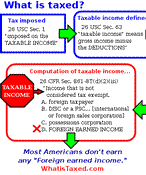
Taxable Income1. Law: Tax imposed

"There is hereby imposed on the taxable income of every individual...a tax" - 26 USC Sec. 1


2. Taxable income

"In general ... the term ``taxable income'' means gross income minus the deductions" - 26 USC Sec. 63


Taxes, Too Complicated?

The Supreme Court has said, it is a "well-settled rule that the citizen is exempt from taxation unless the same is imposed by clear and unequivocal language, and that where the construction of a tax law is doubtful, the doubt is to be resolved in favor of those upon whom the tax is sought to be laid"
- 192 U.S. 397, p-416

Paul Harvey exposes what the IRS wants to hide.
News commentator Paul Harvey, on January 22, 2007, explains how this Supreme Courst decision was put into action:

"Now for what it's worth, the 9th circuit panel in San Francisco has been reversed. The Internal Revenue Service, the IRS, has ruled that Valerie and Robert McKee owed the government $31,000 in unpaid taxes, until Valerie and Robert demonstrated in court that the tax law is so complex nobody can understand it. The court had to agree that the law was indeed so complex that nobody can understand it, and the court reversed itself, and the IRS gets the bill. The government also sought and got us...ha ha ha (laugh)... your government also tried to get a stipulation that this verdict would not be made public, but it just was... Paul Harvey, Good Day!!"

Case Information:
ROBERT C. MCKEE v. COMMISSIONER OF INTERNAL REVENUE
No. 04-74846
IRS No. 4036-03

-- To hear this Paul Harvey sound clip and more, visit HearLiberty.com

3. Gross income

"Except as otherwise provided in this subtitle, gross income means all income from whatever source derived" - 26 USC Sec. 61

* But, tax is still "imposed on the taxable income", not gross income.


4. Except as otherwise provided

"Items of gross income, expenses, losses, and deductions, other than those specified in sections 861(a) and 862(a), shall be allocated or apportioned to sources within or without the United States, under regulations prescribed by the Secretary." - 26 USC Sec. 863


  • What happened to deductions? Why are deductions located under regulations? [And, why is the Treasury Secretary allowed to make the law, in regulations?]
  • There are more items of gross income? What kind of "Items" shall be allocated "under regulations prescribed by the Secretary"?


5. Under regulations prescribed

How are tax regulations written? In Code. http://whatistaxed.com

"(a) Gross income means all income from whatever source derived, unless excluded by law."
"(b) ...To the extent that another section of the Code or of the regulations thereunder, provides specific treatment for any item of income, such other provision shall apply notwithstanding section 61 and the regulations thereunder."

- 26 CFR Sec. 1.61-1

So, notwithstanding [in spite of] what section 61 says about "all income", if "another section of the Code or of the regulations ... provides specific treatment for any item of income", it shall apply.


  • "unless excluded by law"? - Then what is excluded income?
  • Where are the deductions?
  • What section provides "specific treatment for any item of income"?


6. Specific treatment for any item of income [e.g. taxable income, gross income, excluded income, eliminated income, exempt income, expenses, losses, and other deductions]


Search for:

  1. "how to determine taxable income" - 26 CFR Sec. 1.861-8(a)(1)


  2. "specific sources" - Sec. 1.861-8(a)(1)


  3. "specific guidance" - Sec. 1.861-8(a)(1)


  4. "excluded income" - Sec. 1.861-8 and 1.861-8T


  5. "deductions to excluded income" - Sec. 1.861-8(a)(4)


  6. "eliminated income" - Sec. 1.861-8(d), and 1.861-8(d)(2), and 1.861-8T(d)(2)


  7. "eliminated items" - Sec. 1.861-8T(d)


  8. "exempt, excluded, or eliminated income" - Sec. 1.861-8(d)(2)


  9. "exempt, eliminated, or excluded income" - Sec. 1.861-8T(d)(2)(iii)


  10. "the sources of income for purposes of the income tax" - Sec. 1.861-1(a)

  11. "income that is exempt or excluded" - Sec. 1.861-8T(d)(2)


  12. "gross income may include excluded income" - Sec. 1.861-8(b)(1)


  13. "specific rules for allocation and apportionment of deductions" - Sec. 1.861-8(a)(5)(ii)


  14. "expenses, losses, or other deductions" - Sec. 1.861-8T(d)(2)(iii)


  15. The list of taxable income?
    "income that is not considered tax exempt" - Sec. 1.861-8T(d)(2)(iii) - the list of taxable items ("Income ... not ... exempt")


Sec. 861 There are more specific rules written in section 861. Also see boolean search results in regulations, and the search results from statutes - according to law and who is taxed.


The code is precise.Specific sources, specific guidance, excluded income, eliminated income, and even eliminated items are prescribed in Sec. 861.

The "specific treatment for any item" is written in section 861.


Deductions and Excluded Income

For "deductions to excluded income", regulations say "See paragraph (d)(2)." Then, in Sec. 1.861-8(d)(2), it says:

Allocation and apportionment to exempt, excluded, or eliminated income. [Reserved] For guidance, see Sec. 1.861-8T(d)(2).

So, "For guidance", with "exempt, excluded, or eliminated income", we're told, "see Sec. 1.861-8T(d)(2)".

Thus, the obvious questions:

  • What is exempt?
  • What is not exempt?
    Both of these are prescribed exclusively in CFR 1.861-8T(d)(2).


What is exempt?

"Exempt income and exempt asset defined--(A) In general. For purposes of this section, the term exempt income means any income that is, in whole or in part, exempt, excluded, or eliminated for federal income tax purposes."
- CFR Sec. 1.861-8T(d)(2)(ii)


Excluded income
"income that is ...exempt"


What is not ... exempt?

"Income that is not considered tax exempt. The following items are not considered to be exempt, eliminated, or excluded income and, thus, may have expenses, losses, or other deductions allocated and apportioned to them:"
- 26 CFR Sec. 1.861-8T(d)(2)(iii)


Taxable income
"income that is not...exempt"

This is the list of taxable income, located in 26 CFR Sec. 1.861-8T(d)(2)(iii).

Here is what this really says, in plain English...

The list of taxable income?"Income that is not considered tax exempt [income that is taxable]. The following items are [...taxable income] and, thus, may have expenses, losses, and other deductions allocated and apportioned to them:

  (A) "a foreign taxpayer... gross income (whether domestic or foreign source)"
[e.g. "all income from whatever source"]

  (B) "gross income of a DISC or a FSC"
[Domestic International Sales or Foreign Sales Corporation]

  (C) "gross income of a possessions corporations"
[Possessions are places like Puerto Rico, Virgin Islands, etc]

  (D) "Foreign earned income"
[The requirements for making foreign earned income are greater than you think. Search for the definition of "foreign earned income"]

A search technique called a boolean search confirms this is the list of taxable income. Even "exempt income" is defined immediately before the list. And, everything listed is applicable only to foreign related incomes.

* Notice, domestic income has been excluded from the list ("excluded by law"), thus, domestic income is not taxable.


We were told to expect this, by the statutes...

"Except as otherwise provided" - 26 USC Sec. 61

and by the regulations...

"all income from whatever source ...
unless excluded by law"
- 26 CFR Sec. 1.61-1(a).

whatever, unless excludedDomestic income is not in the list of taxable income, it has been excluded by law.


A doubter would say, "But, it doesn't say domestic income is excluded".

It doesn't have to, it's already the accepted condition in (all) statutory construction:

Evidently, it's easier to list what is taxable, than to list what is not taxable.


Gross income "means all income from whatever source".

But, the tax is "imposed on the taxable income".


Taxable Income

The only item in the list of "income that is not ... exempt" applicable to most citizens is item D. If you make "foreign earned income", this means you. However, most Americans do not have any "foreign earned income".

Thus, according to code, most Americans do not owe any federal income tax, because most of their income has been "excluded by law."

Your Honor, Can't you use your computer to search the Code?
Congress; Secretary; IRS; Judges:

If Sec. 861 is frivolous, then where is the law? What is the number of the statute, or regulation, requiring an income tax from US citizens? Thousands of people, including your own IRS agents, have asked you this before, many times, but you, and IRS Commissioner, Mark Everson, have ignored the question. What is the number?

If section 861 is not the law, simply produce the statute or regulation number.

Explain yourselves.

Either, there is a law, or you've all been lying. (Imagine, politicians and bureaucrats, lying)

"everyone who does evil hates the light, and doesn't come to the light, lest his works would be exposed. But he who does the truth comes to the light, that his works may be revealed..."
- John 3:20-21

So easy a child can do it.The truth is, tax law is so simple a child could figure it out. It shouldn't be long before many of them do. (If teenagers can hack into NASA, the Air Force, government computers, etc, they can easily figure out a simple tax code.)

  • CNN: Teen charged with hacking into Air Force system
  • PBS: Interview: anonymous. Young hacker caught breaking into NASA's computers
  • Zdnet: Teen hacks 27 ISPs, gains root access
  • Cooltech: Another teen hacks NASA

The Code does not lie, but judges, politicians, and bureaucrats do.

Congressmen Ron Paul knows the income tax, and the Federal Reserve are a scam. Yet, the Congress, Secretary, and judges, enforce what is clearly a fraud.

The Code remains, still precise, impartial, and truthful.

The conflict of interest involved with judges who are payed by the same system which prosecutes does not simply vanish at the bench. This is not justice. What should we expect a tax judge to say, "Take my job away"? Only under color of law do they rule.

Binding the wicked.Even after one million frivolous rulings, you will not be able to avoid section 861, the truth is manifest. It will always return to the courts because code does not lie.

The slaves are waking up, and the masters will not be able to hide from millions of angry former-slaves.

All of the Titles of Law are suspect of color of law, and candidates for data mining.


Attention Researchers

If any link has disappeared, try to copy and paste the link address at http://www.archive.org

-- DISCLAIMER --

* The intended purpose of this website is to data mine on a computer the Internal Revenue Code, and the Code of Federal Regulations, Title 26, for the "codes" (e.g. taxable income, gross income, excluded income, eliminated income, exempt income, deductions, allocation, apportionment, etc), for rules, and instructions, for determining income tax. The results have been published throughout this website. It should be evident that these search methods can be applied to any Title of Law, or large volume of text, and in any country that has codified laws and rules. See How to Search.

There is nothing for sale at WhatisTaxed.com. Information posted at WhatisTaxed.com is not intended to be and should not be considered as legal advice, it is posted solely for educational purposes. The reader should not rely on information provided herein to determine tax, even if you see that it is written in the law, and believe it to be accurate. (Those who go against, or simply question, the US government, even if those who are questioning are, or were, themselves government agents or employees, regardless of their beliefs, risk prison time, a bad reputation, or worse. Those who speak truth to power have always paid heavily for doing so.)

Do Not accept this website as tax advice, it is tax research and copyright-free (copyleft whatistaxed.com). To contribute research, see How to Search and Contact Us.

We Do Not sell, promote, or advise anything, except the data-mining and reading of tax code with an appropriate code-tool, a computer.

We Do ensure that we find every occurrence of a particular code-term, to establish precisely what is written, and what is not written in the law. When we say no other rule or statutes exists - for example, regarding excluded income, we show you how many files contain this term and how we searched for it with a computer. You can confirm ANY of the laws, rules, and terms yourself, and you should because it is your duty to know and follow the law.

You are responsible for doing your own taxes.

Questions: If you have questions, try asking your Congressperson or Senator.

Have your lawmaker explain these search results ...

  1. "eliminated income" - Sec. 1.861-8(d), 1.861-8(d)(2), 1.861-8T(d)(2)
  2. "eliminated items" - Sec. 1.861-8T(d)
  3. "excluded income" - Sec. 1.861-8 and 1.861-8T
  4. "income that is exempt or excluded" - Sec. 1.861-8T(d)(2)
  5. "specific sources" - Sec. 1.861-8(a)(1)
  6. "specific guidance" - Sec. 1.861-8(a)(1)
  7. "how to determine taxable income" - Sec. 1.861-8(a)(1)
  8. "the rules [of Sec. 1.861-8 ...] for determining taxable income" - Sec. 1.863-1(c)
  9. "income that is not considered tax exempt" [taxable income] - Sec. 1.861-8T(d)(2)(iii)

Have them explain ...

  1. Why are such specific instructions, which are located almost exclusively in Sec. 861, frivolous?
  2. If lawmakers are going to give the Treasury Secretary power ("under regulations prescribed by the Secretary" - 26 USC 863), to create laws for items of income and deductions, then why is most of the CFR code valid, but not Sec. 861 code?
  3. What other definition of "exempt income" is there? According to code, there is only one, defined in Sec. 1.861-8T(d)(2)(ii). And, it's followed immediately by the list of income that is not exempt (i.e. taxable).

Find your Congressperson: http://www.house.gov
Find your Senator: http://www.senate.gov

Answers: If you want answers, you can try asking the press, the American media and foreign media.


* TheCode of Federal Regulations:
When searching, we pay close attention to the rules in 26 CFR, because the law (USC) gives authority to the CFR (regulations). Both the USC and CFR confirm this authority [easily find this authorization with your computer].

"the Federal Income Tax Regulations (Regs) are the official Treasury Department interpretation of the Internal Revenue Code" (Internal Revenue Manual, 4.10.7.2.3.1).
The Code of Federal Regulations are the rules, written in plain English, which both the public and the IRS must follow:
"The Service is bound by the regulations." (Internal Revenue Manual, 4.10.7.2.3.4).

Since "the Service is bound," we can be sure that we are playing by the same rules. It does not require a law degree to understand them. See How to Search and Search Examples.

© Many other logos and images used here are protected by copyright and/or trademark. We believe their use qualifies as fair use under United States copyright law.