|
|
 |
The Short Tour
 "Federal
tax law begins with the Internal Revenue Code (IRC),
enacted by Congress in Title 26 of the United States Code (26 U.S.C.)." "Federal
tax law begins with the Internal Revenue Code (IRC),
enacted by Congress in Title 26 of the United States Code (26 U.S.C.)."
www.irs.gov/taxpros/article/0,,id=98137,00.html
But...
 "The Service is bound by the regulations."
Internal Revenue
Manual, 4.10.7.2.3.4 - www.irs.gov
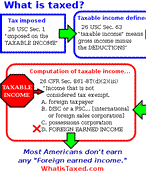
| Tax law begins with law Number One.
USC
Sec. 1
"There is hereby imposed on the taxable income
of [everyone] ... a tax"
Over 500 pages later...
USC
Sec. 63
"In general... the term ``taxable income'' means gross
income minus the deductions"
And two sections before that...
USC
Sec. 61
(a) "Except as otherwise provided ...gross income
means all income from whatever source derived, including
(but not limited to) the following items:..." |
|
 What is "otherwise provided"?
"Federal Income Tax Regulations (Regs) are the official
Treasury Department interpretation of the Internal Revenue Code"
Internal Revenue
Manual, 4.10.7.2.3.1 - www.irs.gov
Regulations are written to carry out statutes
So now we examine the corresponding
regulation to see if it explains what is "otherwise provided."
USC
61 = CFR
61
CFR
Sec. 61(b)
"more common items... are
included in or excluded from gross income entirely,
or treated in some special manner. To the extent that another section
of the Code or of the regulations thereunder, provides specific treatment
for any item of income, such other provision shall apply
notwithstanding section 61"
So, if another section of the Code
or regulations provides "specific treatment for any item ... such
other provision shall apply", in spite of Sec. 61 and it's
claim to all income.
 As otherwise provided...
CFR
Sec. 861-8T(d)(2)(iii)
Income that is not considered tax
exempt. The following items are not considered to be
exempt, eliminated, or excluded income and, thus [are taxable],
may have expenses, losses, or other deductions allocated and
apportioned to them:
(A) In the case of a foreign taxpayer...
(B) the gross income of [international and foreign sales corporations]...
(C) the gross income of a possessions corporation ...
(D) Foreign earned income ...
Income not exempt = taxable
income
Most Americans don't make
foreign earned income.
 "None are more hopelessly enslaved than those who falsely
believe they are free."
"None are more hopelessly enslaved than those who falsely
believe they are free."
- Johann W. Von Goethe |
Regulation
61 is correct, "more common items... are... excluded from
gross income entirely".
Look carefully at the list
of income not exempt. Are your items of income included,
or have they been excluded from gross income entirely?
According to Principles
of Statutory Construction, if a list does not include an item,
it has been excluded purposefully, and is excluded from coverage
or application of the law.
|
Tax Rules must tell us What is Taxed,
not what isn't taxed. Just as rules must explain how to determine the
amount of tax we do owe, not the amount of tax we don't owe.
| Summary
- There is a tax on taxable income.
- "In general... the term 'taxable income' means gross
income minus the deductions..."
- "Except as otherwise provided... gross
income means all income."
- [So, Except...] "more common items... are...
excluded from gross income entirely."
- [And, Except... ] If "another section of
Code or... Regulations... provides specific treatment for
any item of income, such other provision shall apply notwithstanding
[in spite of] section 61."
- [And, Except...] The list of "Income that
is not considered tax exempt ...or excluded income" -
what is taxed, does not include a citizens income when it
is earned within the United States.
- According to well established principles of statutory construction,
if an item is not included in a list, it has been excluded
purposefully and is excluded from coverage or application.
|

Search for ...
•
exlcuded income
• eliminated income
• eliminated
items
• specific sources
• specific guidance
|
Only nonexempt income is
required to be included in gross income...
26CFR1.265-1(b)
Exempt income and nonexempt income. (1) As used in this section, the
term class of exempt income means any class of income (whether or
not any amount of income of such class is received or accrued)
wholly exempt from the taxes imposed by Subtitle A of the Code.
For purposes of this section, a class of income which is considered
as wholly exempt from the taxes imposed by subtitle A includes any
class of income which is:
(i) Wholly excluded from gross income under any provision of Subtitle
A, or
(ii) Wholly exempt from the taxes imposed by Subtitle A under the
provisions of any other law.
(2) As used in this section the term nonexempt income
means any income which is required to be included
in gross income.
Is
taxation theft?

"nonexempt income" ... Where?
 Over
the year, we accumulate what we hope is a tall pile of gross income.
From this pile, we hope to shovel away as much of it as possible, in
the form of deductions, because the remainder is taxable income. However,
exempt income does not even require shoveling, because it is
NOT part of gross income; it is tax exempt. Over
the year, we accumulate what we hope is a tall pile of gross income.
From this pile, we hope to shovel away as much of it as possible, in
the form of deductions, because the remainder is taxable income. However,
exempt income does not even require shoveling, because it is
NOT part of gross income; it is tax exempt.
According to the list of items
of "Income ... not ... exempt" (i.e. "Income That Is Taxable"),
most Americans do not have any taxable income. They have been
excluded from the list, "excluded by law."
 "Expressio unius est exclusio alterius" - Findlaw.com
The reasonable conclusion is that
only income gained from foreign sources is taxable income for a US citizen.
Evidently, the U.S. Federal Income tax is a just scam (surprise,
surprise) by politicians, bureaucrats, and bankers; the people
who play both sides of every issue.
For more information see the Analysis
MORE DETAILS
| |
In tax law, income is referred to as:
- all income
- any income
- items of income
- gross income
- taxable income
- exempt income
- excluded income
- eliminated income
... & other terms of income.
But, the tax is "imposed on the taxable income"
- 26
USC 1 |
According to 26
USC Sec. 7806(b)
"No inference, implication, or presumption
of legislative construction shall be drawn or made by reason of the
location or grouping of any particular section or provision or portion
of this title, nor shall any table of contents, table of cross references,
or similar outline, analysis, or descriptive matter relating to the
contents of this title be given any legal effect."
Taxable or Gross? Where is the income tax prescribed?
26
USC Sec. 861
(a) Gross income from sources within United States
The following items of gross income shall be treated as income from
sources within the United States:
(1) Interest
(2) Dividends
(3) Personal services [...including Compensation for labor]
(4) ...[etc]
(5) ...[etc]
(b) Taxable income from sources within United States
From the items of gross income specified in subsection (a) as being
income from sources within the United States there shall be deducted
[ stuff ]...and other deductions properly apportioned or allocated
thereto ...The remainder, if any, shall be included
in full as taxable income from sources within the United States.
"if any"? ... Where are deductions?
26
USC Sec. 863
"Items of gross income... and deductions,
other than those specified in sections 861(a) and 862(a), shall
be allocated or apportioned to sources within or without the United
States, under regulations prescribed by the Secretary."
According to USC 863, items
of gross income and deductions "shall be allocated ... under
regulations prescribed by the Secretary."
So, we find the corresponding
regulation to see what is prescribed.
USC 863 = CFR
863
26
CFR 1.863-1
(c) Determination of taxable income. The taxpayer's taxable income
from sources within or without the United States will be determined
under the rules of Secs. 1.861-8 through 1.861-14T
for determining taxable income from sources within
the United States. |
|
"The Service is bound by the regulations"
- Internal Revenue
Manual, 4.10.7.2.3.4 - www.irs.gov
So, the IRS must follow "the rules ... for determining taxable
income".
| |
(Your retirement fund didn't just evaporate
in a bubble, it was stolen.)
Garfield
was assassinated in 1881 within weeks after releasing this
statement, during the first year of his Presidency. He died
of blood poisoning on September 19, two months after he was
shot.
Many who have fought the moneychangers
lasted similar lengths of time, except Jesus who was dead within
3 days after throwing the bankers out of the temple.
"Federal Reserve Notes are not Dollars."
-- Russell Munk, Assistant General Counsel, Department of the
Treasury
|
|
|
|
|
Attention Researchers
If any link has disappeared, try to copy and
paste the link address at http://www.archive.org
-- DISCLAIMER --
The intended purpose of this website, WhatisTaxed.com,
is to data mine with a computer the Internal Revenue Code, and
the Code of Federal Regulations, Title 26, for the "codes" (e.g.
taxable income, gross income, excluded income, eliminated income,
exempt income, deductions, allocation, apportionment, etc),
for rules, and instructions, for determining income tax. The
results have been published throughout this website. It should
be evident these search methods may be applied to any Title
of Law, or large volume of text, and in any country that
has codified laws and rules. See How to Search.
Nothing is for sale at WhatisTaxed.com.
Information posted at WhatisTaxed.com should not be
considered legal advice and is solely for educational purposes.
The reader should not rely on information provided herein to
determine tax.
Do not accept this
website as tax advice.
WhatisTaxed.com is only tax research from data mining tax
law.
To contribute - See How to Search, and Contact
Us.
We do not sell, promote, or advise anything,
but data-mining, searching, and reading tax code with the only
appropriate code tool ... your computer.
We do find every occurrence of a particular
code-term to establish precisely what is written, and what is
not written in tax law. When we say, no other rule
or statute exists - for example, regarding excluded
income, we show you how many files contain this important
code term, and how we searched for it with a computer. You can
easily verify any of the laws, rules, or code-terms in question,
and you should verify every result because it is your duty
to know and follow the law. Ignorance is no excuse.
You are
responsible for doing your taxes.
Questions: If you have questions, try asking
your Congressperson or Senator.
Ask your lawmaker to explain these Sec. 861 search
results ...
- "eliminated income" - Sec. 1.861-8(d), 1.861-8(d)(2),
1.861-8T(d)(2)
- "excluded and eliminated items of income" - Sec.
1.861-8T(d)
- "eliminated items" - Sec. 1.861-8T(d)
- "excluded income" - Sec. 1.861-8 and 1.861-8T
- "income that is exempt or excluded" - Sec. 1.861-8T(d)(2)
- "specific sources" - Sec. 1.861-8(a)(1)
- "specific guidance" - Sec. 1.861-8(a)(1)
- "how to determine taxable income" - Sec. 1.861-8(a)(1)
- "the rules [of Sec. 1.861-8 ...] for determining
taxable income" - Sec. 1.863-1(c)
- "Exempt income ... defined" - Sec. 1.861-8T(d)(2)(ii)
- "income that is not considered tax exempt" [i.e.
taxable income] - Sec. 1.861-8T(d)(2)(iii)
Source: http://ecfr.gov
Ask your Congressman and Senator ...
If "Exempt income" is "defined"
in Sec. 861, why is Sec. 861 frivolous?
Find your Congressperson: http://www.house.gov
Find your Senator: http://www.senate.gov
Answers: If you want answers, you can try
asking the press - the American
media and foreign
media.
The Code of Federal Regulations
When searching tax law, we pay close attention
to 26 CFR...
"the Official Interpretation"
"Federal Income Tax Regulations
(Regs) are the official Treasury Department interpretation of
the Internal Revenue Code"
- Internal
Revenue Manual, 4.10.7.2.3.1
"Federal Tax Regulations pick
up where the Internal Revunue Code (IRC) leaves off by providing
the official interpretation of the IRC"
- http://www.irs.gov/taxpros/article/0,,id=98137,00.html
The Code of Federal Regulations are the rules, written
in plain English, which both the public and the IRS must follow:
"The Service is bound by the
regulations."
- Internal
Revenue Manual, 4.10.7.2.3.4
Since "the Service is bound," we can be sure that
we are playing by the same rules. It does not require a law
degree to understand them. See How to Search and Search Examples.
|
|