|
|
 |
If you use MS Windows, you will get these results.
Or just search at ecfr.gov
(Right-click, Open in New Window)
|
The first rule says...
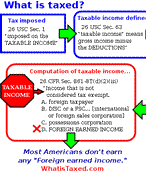
"The tax imposed is upon taxable income"
(1 file found): Sec. 1.
So we find
"the rules... for determining taxable income"
(1 file found): Sec. 863. [This can be seen by finding "determining
taxable income"]
Sec. 863 says "the rules" are found
in Sec. 861. This must be true, because it's the only section
in the Code of Federal Regulations (CFR) with the instructions
for
"how to determine taxable income" (1 file
found): Sec. 861.
Sec. 861 is the only section telling us:
"the sources of income for purposes of the income
tax" (1 file found): Sec. 861.
Sec. 861 is also the only section with all
the following terms. And, all of the terms occur in just one
(1) paragraph:
"specific", "guidance", "rules", "taxable", "income",
"apply", "how to", "taxable income" (1 file found): Sec.
861. [Requires a tool, such as WinMerge. Or, find up to three
terms at a time by using the boolean search at ecfr.gov
]
Only one (1) section in the CFR prescribes
"taxable income from sources within the United
States shall consist of " (1 file found): Sec.
861.
"The rules" tell us the taxable
income by using two lists.
The first list we are pointed to prescribes
the "specific sources", and "sections
of the Code which require the determination of taxable income"
(1 file found): Sec. 861. No other "sections" "require" this
determination.
It's here that we notice some of our income
is not even a part of gross income:
"the following rules shall apply to... income
that is exempt" (1 file found): Sec. 861.
The second list tells us the specific items
of income which are taxable, in a paragraph titled
"Income that is not considered tax exempt"
[i.e. "Income that is taxable"] (1 file found): Sec. 861.
Only Sec. 861 gives rules for determining taxable
income and excluded income.
"determining taxable income" and "excluded income"
(1 file found): Sec. 861. In general, wouldn't finding one of
these also determine the other?
These rules, and many more, agree,
only the "more common items" from sources
outside the United States, are taxable income for a US citizen.
According to the code, it's one item, "Foreign earned
income".
We can be certain we are looking at the correct
rules, because
"The rules contained in this section apply in
determining taxable income of the taxpayer" (1 file found):
Sec. 861. No other section in the tax regulations claims to
have these rules.
We can be even more certain, because only
one paragraph in the CFR contains all three terms:
"rules" and "prescribing" and "taxable income"
(2 file(s) found): Sec. 861.
And only one section contains both of these
terms:
"prescribing" and "excluded income" (1 file
found): Sec. 861.
According to these two code-terms, section
861 is the section which covers
"items" and "excluded income" (3 file(s)
found): Sec. 861 and 861-8T.
And, according to these two code-terms, section
861 is the section regarding
"sources" and "excluded income" (5 file(s)
found): Sec. 861 and 861-8T.
The same applies to the sections of the CFR...
"sections" and "excluded income" (5 file(s)
found): Sec. 861 and 861-8T.
Even more impressive, Sec. 861 is the only
section telling us
"how to determine tax" (1 file found): Sec.
861. [See it now, at ecfr.gov
Include an asterisk, e.g. how to determine tax* ]
Use any words you wish to ask "how to
determine tax." You can try to "add" or "figure"
your tax. Or, try to "calculate" or make a "computation."
You can even try "totaling" or "determining"
your tax. Try any action word you want upon tax, but
section 861 will be the final result, or the obvious section
to apply. You will soon see that the items and sources
of income of most Americans are excluded from taxation, according
to code. |
|
|
The fact is, anyone can confirm exactly who, where, and what
"the rules" do cover, simply by reading about the scope. Logically,
we could also look up the list of "sections of the Code
which require the determination of taxable income", or
even the list of "Income that is not considered tax exempt",
to see exactly whose income is listed.
We can come to the same conclusion starting
from many different points within the regs (and statutes), but
there is only one reasonable conclusion: Most US citizens
do not have any taxable income.
Are we being scammed by politicians
and public servants?
Why aren't the vital
instructions, and rules, for "taxable income",
"excluded income", or even something as simple
as, "how to determine taxable income," not found
up front, in section 1 or 2, or at least the top 10 sections?
Only one section has
the "rules" for both "determining
taxable income" and "excluded income",
which is logical because at some point, finding one determines
the other.
Why is this essential
information placed thousands of pages later, in section
861?
Why do the rules say
something other than what we have been led to believe?
"Unless excluded",
right? But, only seven (7) files even mention "excluded
income". Only one section provides "specific
guidance", by "prescribing rules",
and lists "specific sources", and "determining
taxable income of the taxpayer", and there are
many more.
Why should it require
a computer to search through all of the text within the
tax regulations, just to find out, what is taxable income,
and what is excluded? How hard does it have to be? Is
this because of the irresponsibility of the Treasury,
or just plain fraud? |

Scammed by public servants? Politicians? |
Fortunately, unlike many books,
the code in the tax rulebook is not open to interpretation.
As with computer instructions, it either compiles or it doesn't.
Objects are declared, conditions exist, and actions occur. Specific
instructions are coded for us to follow. And, the instructions
are written only once, and thus, cannot be confused. Our conclusion
can be confirmed, absolutely, with a computer. According to
code, only "Foreign earned income" is taxable for
U.S. citizens. Do you have any? |
 |
 |
 |
 |
"rules":
(2557 file(s) found)
"taxable income": (817
file(s) found)
"prescribing": (15 file(s)
found)
"excluded income": (7 file(s) found)
|
"rules" and
"prescribing" and "taxable income" (2 files)
"rules" and "prescribing" and "excluded
income" (1 file)
- Sec. 861 |
|
 |
 |
 |
 |
|
|
|
|
"the
rules": (1338 file(s) found)
"taxable income":
(817 file(s) found)
"determining tax": (49
file(s) found) |
Within millions of words, this prescription occurs
just once
"the rules... for determining taxable income"
(1 file found): Sec. 863
|
|
|
|
|
|
Compare a
dozen terms, indicating how to determine taxable income to the rule
currently used and ask yourself, which rules are more clear, accurate,
and specific?
Don't be distracted
with the idea that if we didn't have income taxes, we couldn't
have our government services. First, that is a completely separate issue
from following the rules already written. Second, as early as the 1980s,
our President, Ronald Reagan, along with sources like Paul Harvey News,
were telling us that none of our income taxes are used to pay for our
social services.
"100% of what is collected
is absorbed solely by interest on the Federal Debt ... all individual
income tax revenues are gone before one nickel is spent on the
services taxpayers expect from government"
-- Grace
Commission report (PPSS) submitted to President Ronald Reagan
on January 15, 1984 (wiki)
There are numerous other
taxes to pay for our government services. Income taxes
are used to pay for other things... |
|
"Money is a new form
of slavery, and distinguishable from the old simply by the fact that
it is impersonal -- that there is no human relation between master and
slave."
-- Leo Tolstoy
For computing income taxes, the
ideal condition occurs when we have found every deduction, and exempt
or excluded income. Finding such code-words is easily done with
a computer.
|
|
|
|
Attention Researchers
If any link has disappeared, try to copy and
paste the link address at http://www.archive.org
-- DISCLAIMER --
The intended purpose of this website, WhatisTaxed.com,
is to data mine with a computer the Internal Revenue Code, and
the Code of Federal Regulations, Title 26, for the "codes" (e.g.
taxable income, gross income, excluded income, eliminated income,
exempt income, deductions, allocation, apportionment, etc),
for rules, and instructions, for determining income tax. The
results have been published throughout this website. It should
be evident these search methods may be applied to any Title
of Law, or large volume of text, and in any country that
has codified laws and rules. See How to Search.
Nothing is for sale at WhatisTaxed.com.
Information posted at WhatisTaxed.com should not be
considered legal advice and is solely for educational purposes.
The reader should not rely on information provided herein to
determine tax.
Do not accept this
website as tax advice.
WhatisTaxed.com is only tax research from data mining tax
law.
To contribute - See How to Search, and Contact
Us.
We do not sell, promote, or advise anything,
but data-mining, searching, and reading tax code with the only
appropriate code tool ... your computer.
We do find every occurrence of a particular
code-term to establish precisely what is written, and what is
not written in tax law. When we say, no other rule
or statute exists - for example, regarding excluded
income, we show you how many files contain this important
code term, and how we searched for it with a computer. You can
easily verify any of the laws, rules, or code-terms in question,
and you should verify every result because it is your duty
to know and follow the law. Ignorance is no excuse.
You are
responsible for doing your taxes.
Questions: If you have questions, try asking
your Congressperson or Senator.
 Ask your lawmaker to explain these Sec. 861 search
results ...
Ask your lawmaker to explain these Sec. 861 search
results ...
- "eliminated income" - Sec. 1.861-8(d), 1.861-8(d)(2),
1.861-8T(d)(2)
- "excluded and eliminated items of income" - Sec.
1.861-8T(d)
- "eliminated items" - Sec. 1.861-8T(d)
- "excluded income" - Sec. 1.861-8 and 1.861-8T
- "income that is exempt or excluded" - Sec. 1.861-8T(d)(2)
- "specific sources" - Sec. 1.861-8(a)(1)
- "specific guidance" - Sec. 1.861-8(a)(1)
- "how to determine taxable income" - Sec. 1.861-8(a)(1)
- "the rules [of Sec. 1.861-8 ...] for determining
taxable income" - Sec. 1.863-1(c)
- "Exempt income ... defined" - Sec. 1.861-8T(d)(2)(ii)
- "income that is not considered tax exempt" [i.e.
taxable income] - Sec. 1.861-8T(d)(2)(iii)
Source: http://ecfr.gov
Ask your Congressman and Senator ...
If "Exempt income" is "defined"
in Sec. 861, why is Sec. 861 frivolous?
Find your Congressperson: http://www.house.gov
Find your Senator: http://www.senate.gov
Answers: If you want answers, you can try
asking the press - the American
media and foreign
media.
The Code of Federal Regulations
When searching tax law, we pay close attention
to 26 CFR...
"the Official Interpretation"
"Federal Income Tax Regulations
(Regs) are the official Treasury Department interpretation of
the Internal Revenue Code"
- Internal
Revenue Manual, 4.10.7.2.3.1
"Federal Tax Regulations pick
up where the Internal Revunue Code (IRC) leaves off by providing
the official interpretation of the IRC"
- http://www.irs.gov/taxpros/article/0,,id=98137,00.html
The Code of Federal Regulations are the rules, written
in plain English, which both the public and the IRS must follow:
"The Service is bound by the
regulations."
- Internal
Revenue Manual, 4.10.7.2.3.4
Since "the Service is bound," we can be sure that
we are playing by the same rules. It does not require a law
degree to understand them. See How to Search and Search Examples.
|
|