|
|
 |
|
Florida state doesn't have an income tax, but
you might not know it by reading their law. This is a side-by-side
comparison of the laws & regulations for US Federal income
tax with Florida state income tax law.
|

Poor Albert didn't have a computer. |
Comparing US Federal Tax Law &
Florida State Tax Law
|
 1. 1.
The Federal government and Florida both have power
or authority to collect taxes.
|
| FEDERAL |
FLORIDA |
US Constitution Amendment XVI "The
Congress shall have power to lay and collect
taxes on incomes, from whatever source derived" |
Florida Title XIV Taxation 220.701 "Collection
authority.--The department shall collect the taxes
imposed by this chapter" |
2.
Federal law imposes a tax upon taxable income,
in Florida it's net income [Federal law also used to refer to
it as net income]. If you wish, you can use these image links
to follow along (open each in a new window or tab by right-clicking). |
| FEDERAL LAW - United States Code, Title 26 |
FLORIDA STATE
TAX LAW - Title 14 |
| Tax
imposed
26 USC Sec. 1
"There is hereby imposed on the taxable income
of - [(a) every married individual,
(b) every head of household, (c) every... unmarried individual,
(d)... (i.e. citizen)] a tax"
|
Tax imposed
220.11 (1)
"A tax measured by net income is hereby imposed
on every taxpayer ... for the privilege of conducting
business, earning or receiving income in this state, or
being a resident or citizen of this state."
[How can it be "on every taxpayer...
for... being a citizen"? Florida has no State income tax.
Yet, a tax on every citizen is actually written into Florida law,
like the imposing Federal law, opposite.] |
3.
- Taxable income means gross income minus deductions.
- Gross income means all income.
|
| FEDERAL LAW |
FLORIDA STATE
LAW |
|
26 USC Sec. 63
(a) "the term 'taxable income' means gross income
minus the deductions allowed"
26 USC Sec. 61
(a) "General definition ... Except as otherwise provided
... gross income means all income from whatever
source derived, including (but not limited to) the following
items:
(1) Compensation for services, including fees, commissions, fringe
benefits, and similar items;
(2) Gross income derived from business;
(3) Gains derived from dealings in property;
(4) Interest;
(5) Rents;... "
|
196.012 Definitions.
(10) "Gross income means all income from whatever
source derived, including, but not limited to, the following
items... : earned income, income from investments, gains derived
from dealings in property, interest, rents, royalties, dividends,
annuities, income from retirement plans, pensions, trusts, estates
and inheritances, and direct and indirect gifts."
[So, it's "all income" in
both cases, but "minus the deductions allowed"] |
4.
There
are many "deductions" to examine (916 files
in 2004). Federal law says "Except as otherwise provided",
so we continue searching for 1) deductions, and 2) the list of
taxable income.
|
| FEDERAL LAW |
FLORIDA STATE
LAW |
|
['...as otherwise provided'? ]
26 USC Sec. 863.
"Special rules for determining source
(a) Allocation under regulations
Items of gross income... and deductions,
other than those specified in sections 861(a) and 862(a), shall
be allocated or apportioned to sources within or without
the United States, under regulations prescribed by the
Secretary."
[But, USC 861 and 862 only have one deduction.
So where are the plural - 'deductions'?] |
[Net income is "adjusted federal income", 220.12]
<---- moving to federal side, focusing on deductions |
5.
USC 863 tells us that more "deductions" exist,
and "shall be allocated... under regulations prescribed by
the Secretary". USC 863's corresponding regulation
is CFR 863.
|
| FEDERAL REGULATIONS
(CFR) |
FLORIDA STATE |
26 CFR Sec. 863-1
"Allocation of gross income ...
(c) Determination of taxable income. The taxpayer's
taxable income from sources within or without the United States
will be determined under the rules of
Sec. 1.861-8 through 1.861-14T for
determining taxable income from sources within the
United States."
["the rules... for determining taxable income"
(1 file found). Only one regulation in the CFR contains this term
- among millions of words. It clearly commands "taxable income...
will be determined under the rules of Sec. 1.861-8"] |
[Net income is "adjusted
federal income", 220.12]
<---- continuing with federal side,
how to determine taxable income |
6.
Next,
examining 861-8, we see the "specific guidance" (1 file)
for the rules for deductions. The term, specific guidance,
is written only once in the entire Income Tax, in sec. 861.
|
| FEDERAL REGULATIONS |
FLORIDA STATE |
|
26 CFR 861-8
"Computation of taxable income..."
(a)(1) "Scope. This section provides specific
guidance ... prescribing rules for the allocation...
of... deductions of the taxpayer. The
rules contained in this section apply in determining taxable
income of the taxpayer... See... (f)(1) of this section
for a list..."
(2) "A taxpayer... is required to allocate deductions
to a class of gross income"
(3) "a 'class of gross income' ...may consist of
one or more items... of gross income
enumerated in section 61, namely:
(i) Compensation for services, including fees, commissions,
and similar items;
(ii) Gross income derived from business;
(iii) Gains derived from dealings in property;
(iv) Interest;..."
(4) "... Gross income ... may include, or consist
entirely of, excluded income. See paragraph (d)(2)
of this section"
(b) "Allocation--(1) ...gross income to which a specific
deduction is definitely related is referred to as a "class
of gross income'' and may consist of one or more items of gross
income. See... paragraph (d)(2) of this section
which provides that a class of gross income may include
excluded income."
(d)(2) "For guidance, see Sec. 1.861-8T(d)(2)". |
Florida State Income Tax
[Net income is "adjusted federal income", 220.12]
<---- continued with federal,
how to determine taxable income |
7.
Saying
the above once again - "This section provides specific guidance...
[and ] Gross income [including income enumerated in the given
list] ... may include, or consist entirely of, excluded income...
For guidance, see Sec. 1.861-8T(d)(2)"
And finally, Federal law compared
to its Florida equivalent.
|
| FEDERAL |
FLORIDA STATE |
|
[What
is taxed: Federal - the exact list, determined by measurable
and repeatable results, see How to Search]
26 CFR Sec. 861-8T(d)(2)
(i) the following rules shall apply to take account of income
that is exempt or excluded...with respect to allocation and apportionment
of deductions.
(ii) ...the term exempt income means any income that is, in whole
or in part, exempt, excluded, or eliminated for federal income
tax purposes.
(iii) Income that is not considered
tax exempt. The following items are not ... exempt,
eliminated, or excluded...and, thus [...thus are
taxable]:
(A) foreign taxpayer
(B) DISC or a FSC
(C) possessions corporation...
(D) Foreign earned income as defined in section
911 and the regulations thereunder |
[What
is taxed: in Florida - the exact list, also determined
by measurable and repeatable results, see How to Search]
[Federal regulations use many pages to
show what Florida law can show in a fraction of pages.]
220.02 Legislative intent.-- (1) It is the intent
of the Legislature in enacting this code to impose a tax
upon all
corporations,
organizations,
associations, and other
artificial entities... Subject ... for the privilege
of conducting business, deriving income, or existing
|
| |
|
| FEDERAL |
FLORIDA STATE |
|
Result: An individual citizen is not
taxed on domestic income.
|
Result: An individual citizen is not
taxed on domestic income.
|
What happened... to "A tax...
imposed on every taxpayer... being... a citizen", on "all income"
in Florida?
In each case, we are eventually shown the exact list
of what is taxed. Both Florida and the Feds make it clear, but in the
federal tax, "the following items are not ... excluded" [i.e. taxable].
Ultimately, we find that only GROSS INCOME is "all
income from whatever source." TAXABLE INCOME is a completely different
subject and must be specifically listed, because EXEMPT INCOME
is not specified. What is taxed is listed in the Florida code,
and also listed in the Code of Federal Regulations.
| According to
the Principles of Statutory Construction, if a list in a statute
does not include a particular item, it has been excluded
from the list, and is "excluded from the statute's coverage
or application."
The courts, the laws, and regs, tell us that
we are "subject to" and "liable to" the income
tax, and accurately so, but if we see what we are subject
for, and liable for, we see what is really taxed.
It may apply to you, or it may not. Only by finding who, what,
when, where, and how can we accurately determine any tax. Such
instructions and information are required, and thus, are provide
in the regulations.
|
|
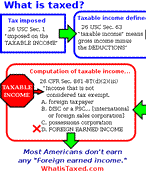
US citizens do owe a tax, but only upon "Foreign
earned income". This is why the code says "the remainder,
if any, shall be included in full as taxable income". Most
US citizens don't have foreign earned income, which is why CFR 61(b)
can say "more common items... are... excluded... entirely."
|
|
|
|
Attention Researchers
If any link has disappeared, try to copy and
paste the link address at http://www.archive.org
-- DISCLAIMER --
The intended purpose of this website, WhatisTaxed.com,
is to data mine with a computer the Internal Revenue Code, and
the Code of Federal Regulations, Title 26, for the "codes" (e.g.
taxable income, gross income, excluded income, eliminated income,
exempt income, deductions, allocation, apportionment, etc),
for rules, and instructions, for determining income tax. The
results have been published throughout this website. It should
be evident these search methods may be applied to any Title
of Law, or large volume of text, and in any country that
has codified laws and rules. See How to Search.
Nothing is for sale at WhatisTaxed.com.
Information posted at WhatisTaxed.com should not be
considered legal advice and is solely for educational purposes.
The reader should not rely on information provided herein to
determine tax.
Do not accept this
website as tax advice.
WhatisTaxed.com is only tax research from data mining tax
law.
To contribute - See How to Search, and Contact
Us.
We do not sell, promote, or advise anything,
but data-mining, searching, and reading tax code with the only
appropriate code tool ... your computer.
We do find every occurrence of a particular
code-term to establish precisely what is written, and what is
not written in tax law. When we say, no other rule
or statute exists - for example, regarding excluded
income, we show you how many files contain this important
code term, and how we searched for it with a computer. You can
easily verify any of the laws, rules, or code-terms in question,
and you should verify every result because it is your duty
to know and follow the law. Ignorance is no excuse.
You are
responsible for doing your taxes.
Questions: If you have questions, try asking
your Congressperson or Senator.
 Ask your lawmaker to explain these Sec. 861 search
results ...
Ask your lawmaker to explain these Sec. 861 search
results ...
- "eliminated income" - Sec. 1.861-8(d), 1.861-8(d)(2),
1.861-8T(d)(2)
- "excluded and eliminated items of income" - Sec.
1.861-8T(d)
- "eliminated items" - Sec. 1.861-8T(d)
- "excluded income" - Sec. 1.861-8 and 1.861-8T
- "income that is exempt or excluded" - Sec. 1.861-8T(d)(2)
- "specific sources" - Sec. 1.861-8(a)(1)
- "specific guidance" - Sec. 1.861-8(a)(1)
- "how to determine taxable income" - Sec. 1.861-8(a)(1)
- "the rules [of Sec. 1.861-8 ...] for determining
taxable income" - Sec. 1.863-1(c)
- "Exempt income ... defined" - Sec. 1.861-8T(d)(2)(ii)
- "income that is not considered tax exempt" [i.e.
taxable income] - Sec. 1.861-8T(d)(2)(iii)
Source: http://ecfr.gov
Ask your Congressman and Senator ...
If "Exempt income" is "defined"
in Sec. 861, why is Sec. 861 frivolous?
Find your Congressperson: http://www.house.gov
Find your Senator: http://www.senate.gov
Answers: If you want answers, you can try
asking the press - the American
media and foreign
media.
The Code of Federal Regulations
When searching tax law, we pay close attention
to 26 CFR...
"the Official Interpretation"
"Federal Income Tax Regulations
(Regs) are the official Treasury Department interpretation of
the Internal Revenue Code"
- Internal
Revenue Manual, 4.10.7.2.3.1
"Federal Tax Regulations pick
up where the Internal Revunue Code (IRC) leaves off by providing
the official interpretation of the IRC"
- http://www.irs.gov/taxpros/article/0,,id=98137,00.html
The Code of Federal Regulations are the rules, written
in plain English, which both the public and the IRS must follow:
"The Service is bound by the
regulations."
- Internal
Revenue Manual, 4.10.7.2.3.4
Since "the Service is bound," we can be sure that
we are playing by the same rules. It does not require a law
degree to understand them. See How to Search and Search Examples.
|
|